
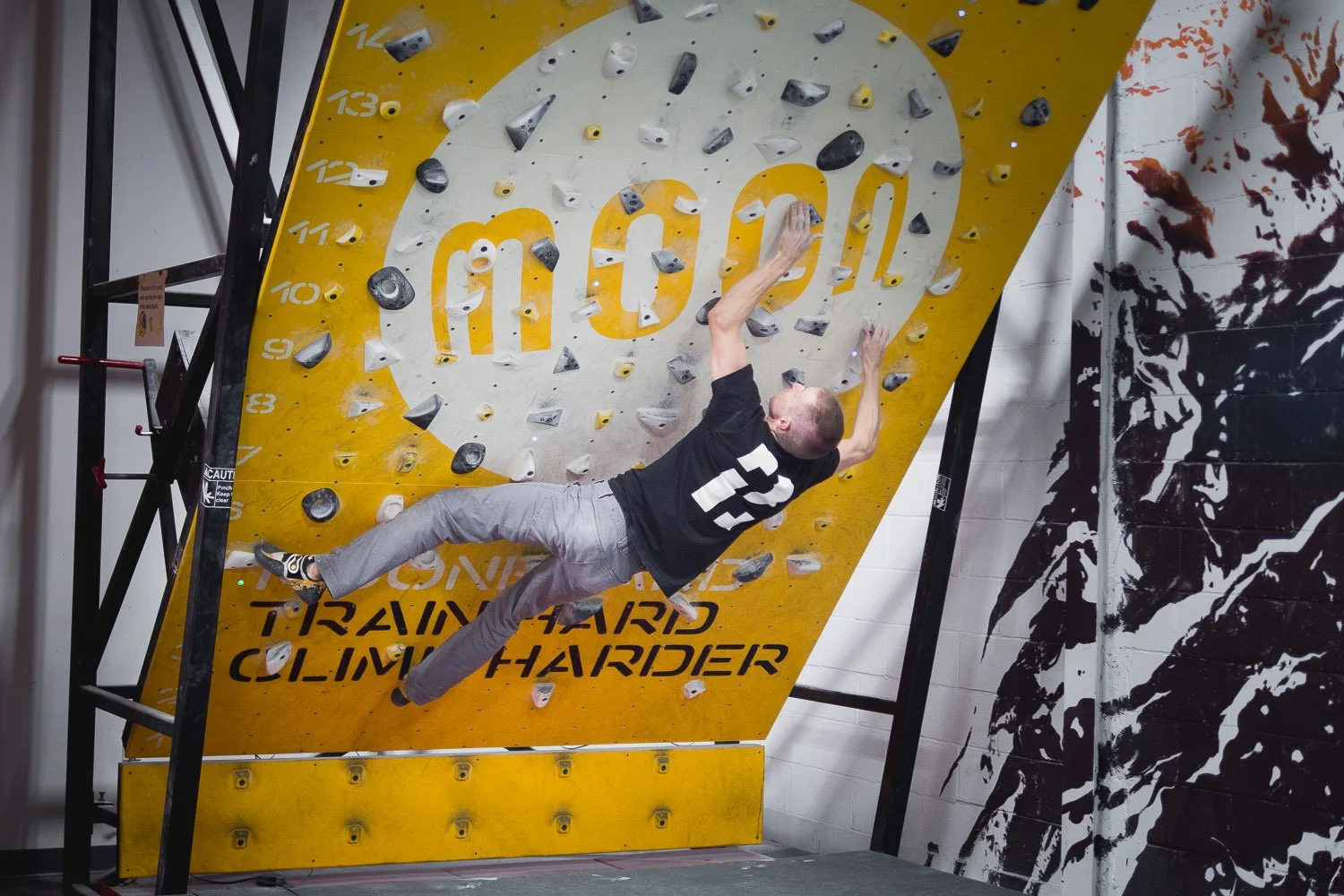
Most climbers approach the training board in the same way they approach outdoor boulders—they project one hard climb after another. There's nothing wrong with that, but if your goal is to get stronger and arrive at peak form, I think there's a better way.
There's a really powerful training strategy that I use on the Kilter, Tension and Moonboard all the time, and it shifts away from the standard approach most climbers take.
It's simple and incredibly effective. In fact, I’ve never used it with a climber without seeing them get stronger.
It's particularly useful as a pre-season strategy to bring a climber into peak form before they jump into the climbing season, but it can be used at any time. There are plenty of climbers I work with who use this multiple times a year.
Instead of climbing right at or beyond your limit, you can shift the challenge level towards a place of higher success. You're still climbing difficult boulders, but you're climbing at a level where you can build repeatable volume, allowing your body to adapt to the training stress whilst removing a little bit of the volatility from the session.
Everything becomes more predictable and, because of that, you can build genuine progression into your training. That's notoriously difficult in climbing because the environment is always changing and training stress is hard to track.
Find Your 90% Success Level
You can try this out on any digital training board, like the Tension Board, Kilter Board or MoonBoard.
The first thing to do is calibrate your 90% success level. A good way to do this is to spend a few sessions finding your 100% level. Which grade level can you send first try every single time? Once you figure that out, move up one grade. This is just a starting point for your 90% level—you'll update this as you gain experience on the board.
Build Your Training Board List
Next we want to build out a list of climbs at this level. I like to use the Most Ascents filter on the app because I find the difficulty level has been somewhat normalised by the thousands of climbers who have completed them.
Let's say your 90% success level is around 6C+ / V5.
Pull up the most climbed list of that grade and start sending.
In your first session you might complete the first six climbs on the list.
The next session you complete the same six and add a seventh.
The session after that you complete seven and add an eighth.
If you get stuck on a climb give it a couple of goes then ditch it from the list.
It's helpful to limit your session attempts no matter how many climbs are on your list. A good session attempt limit is around 12-14 attempts in total.
Why This Progression Works
Over the course of five or six weeks your list gradually grows until eventually you send 12 or more board problems successfully in a session.
You're building a circuit that continually expands.
The individual climbs don't change.
Yet your body continues to adapt.
Your capacity increases, your strength improves, and your ability to repeat difficult climbing keeps growing.
The training stimulus comes from increasing the amount of difficult climbing you can successfully repeat, not from constantly searching for harder climbs.
So slowly build your list and then let the progressive training load do its magic.
I find it useful to think about this much more like strength training than a standard projecting session.
Take deadlifting for example.
You don't get stronger by repeatedly failing on reps.
You get stronger by building repeatable volume at a challenging intensity that your body can consistently adapt to.
The same principle applies to training boards.
Bring Yourself Into Peak Form
So if you're training on the boards, try this out for an 8-week block. Make sure you're coming into each session well recovered. This session works really well with only one board session each week.
Keep the quality high, keep the fatigue low, and enjoy building the progression.
Once you're comfortably climbing 12 problems in a session at your 90% level, you'll probably find yourself at or very close to peak form.
At that point, go and try some of your projects.
Then move your 90% level up, build a new list, and start the process again.
Thanks for reading,
Simon

Enjoyed this article?
Join How We Learn To Climb for one new essay each week on training, movement and the philosophy of becoming a better climber.